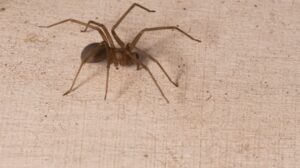
A spider crawling across your wall can raise an important question: is it a harmless house spider or a brown recluse hiding inside your home? While these two types of spiders may look similar, their differences often come down to small details in their appearance, behavior, and preferred environments. Identifying those differences is a key part of professional spider control, where accurate species recognition helps determine the right approach for managing spider activity inside your home.
Identifying Features of Brown Recluse Spiders
Brown recluse spiders are one of the most commonly misidentified spiders found inside homes because their appearance can overlap with several harmless species. Many homeowners assume that any brown spider they find indoors is automatically a brown recluse, but proper identification requires looking at multiple characteristics rather than relying on color alone.
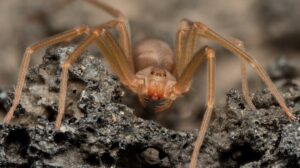
Brown recluse spiders typically have a light brown to tan body with a darker violin-shaped marking on the upper portion of their body near the head. While this marking is often associated with brown recluse identification, it is not always easy to see and should not be the only feature used when determining the species.
Several characteristics are commonly associated with brown recluse spiders:
- A tan or light brown body with a darker marking near the front section of the body
- Six eyes arranged in three pairs instead of the eight eyes found on most spider species
- Long, thin legs without noticeable stripes or bands
- A smooth appearance compared to many other spiders with more visible hair or patterns
- A tendency to remain hidden rather than staying in exposed areas
Brown recluse spiders are also different from many household spiders because they are not dependent on large webs to capture prey. They are active hunters that move around searching for insects rather than waiting for prey to become trapped.
Their secretive behavior is one reason they are often difficult to identify. They tend to avoid areas with frequent activity and may remain unnoticed until homeowners discover them unexpectedly.
Common Characteristics of Harmless House Spiders
Not every spider found inside a home is a cause for concern. Many household spiders are harmless and can actually provide natural pest control by feeding on flies, mosquitoes, gnats, and other small insects. These spiders typically avoid people and are more focused on finding areas where they can build webs and capture prey.
Unlike brown recluse spiders, many common house spiders have noticeable features that make them easier to distinguish. Their appearance, web-building habits, and typical behavior often provide clues that they are not a species homeowners need to worry about.
Common characteristics of harmless house spiders include:
- Visible patterns and markings on their bodies: Many common house spiders have stripes, spots, or contrasting colors across their abdomen and legs. These markings can vary depending on the species but are often more noticeable than the mostly plain appearance of a brown recluse spider.
- Web-building behavior in open areas: Many harmless house spiders create webs in corners, window frames, ceilings, garages, and other locations where insects frequently travel. A spider sitting in a web is often more likely to be a common house spider than a brown recluse, which typically does not rely on large visible webs to catch prey.
- Legs with noticeable bands or color variations: Unlike brown recluse spiders, which usually have uniformly colored legs, many harmless house spiders have darker rings, stripes, or differences in shading along their legs that can help separate them from other species.
- A preference for exposed areas with insect activity: House spiders often remain near windows, doors, lights, and other areas where insects gather. These locations provide a steady food source and allow them to maintain their webs without frequent disturbance.
- A tendency to stay near their web instead of actively roaming: Many harmless house spiders remain in one area and wait for insects to become trapped. Brown recluse spiders are different because they are active hunters that move around in search of prey rather than depending on a visible web.
Finding a harmless house spider inside your home is common and does not automatically indicate a serious pest issue. In many cases, these spiders are simply taking advantage of available insects and sheltered areas. However, frequent spider activity may indicate that other pests are present and providing a reliable food source.
Key Differences Between Brown Recluse Spiders and House Spiders
The biggest challenge with spider identification is that appearance alone can sometimes be misleading. Several harmless spiders have brown coloring, while some brown recluse characteristics may not be obvious without a closer inspection.
The location and behavior of the spider can provide important clues when determining the difference between species. Brown recluse spiders are generally more secretive and spend much of their time away from areas with frequent activity. They are less likely to be found sitting in visible webs and are more likely to move around while searching for prey.
House spiders are usually easier to notice because many species create webs in predictable locations. A spider sitting in a web near a window, ceiling corner, or light source is typically more consistent with a harmless house spider than a brown recluse.
The main differences between these spiders include:
- Body appearance: Brown recluse spiders usually have a plain brown appearance, while many house spiders have visible patterns, spots, or markings.
- Web activity: House spiders commonly build webs in open areas, while brown recluse spiders generally do not create large visible webs.
- Behavior: Brown recluse spiders are more secretive and actively search for prey, while many house spiders remain near their webs.
- Leg appearance: Brown recluse spiders usually have plain-colored legs, while many harmless spiders have noticeable bands or color changes.
- Eye arrangement: Brown recluse spiders have six eyes arranged in pairs, which separates them from most common household spiders.
Looking at several characteristics together provides a much more reliable identification than focusing on a single feature.
Signs That Spider Activity May Require Attention
Finding an occasional spider inside your home is common, especially when insects are active or outdoor conditions encourage spiders to move closer to structures. However, repeated sightings or increasing spider activity may indicate that conditions around your property are supporting a larger pest issue.
Spider activity is often connected to the availability of food. Since spiders feed on insects, an increase in spiders may sometimes indicate that another pest population is present inside or around the home.
Signs that may require closer attention include:
- Finding spiders repeatedly throughout different areas of the home
- Seeing increasing numbers of webs around windows, doors, garages, or entry points
- Discovering egg sacs near areas where spider activity is present
- Noticing an increase in insects that may serve as a food source
- Finding spiders in areas where people frequently spend time
Brown recluse spiders can be especially difficult to monitor because they are naturally secretive. If homeowners continue finding spiders but cannot confidently identify the species, a closer inspection can provide more clarity.
Preventing Brown Recluse Spiders and Other Indoor Spider Problems
Reducing spider activity starts with limiting the conditions that attract spiders and the insects they feed on. While completely preventing every spider from entering a home is difficult, homeowners can take practical steps to reduce opportunities for spiders to establish themselves indoors.
Keeping indoor and outdoor areas clean, reducing clutter, and sealing possible entry points can make a property less attractive to spiders. Removing the conditions that attract insects can also reduce the food sources that encourage spider activity.
Effective prevention steps include:
- Sealing cracks around foundations, doors, windows, and utility openings
- Removing unnecessary clutter from garages, closets, and storage areas
- Cleaning spider webs regularly from indoor and outdoor areas
- Reducing insect activity around the property
- Maintaining landscaping and keeping vegetation away from exterior walls
Outdoor maintenance is also important. Overgrown vegetation, excess moisture, and areas with heavy insect activity can create conditions where spiders are more likely to remain near the home.
Getting the Right Help for Spider Identification and Control
Knowing what kind of spider is inside your home is an important step in determining the right way to respond. Brown recluse spiders and harmless house spiders can share similar colors and features, but differences in their behavior, habits, and environments can reveal what you are actually dealing with. A closer evaluation can help determine whether the presence is simply a common household species or a situation that requires further attention.
If you are unsure whether the spider you found is a brown recluse or a harmless house spider, Allen Pest Management can help determine what species you are dealing with and what steps are appropriate for your home. Our team serves Northwest Arkansas homeowners with targeted pest solutions based on the specific spider concerns present, helping remove the guesswork when it comes to identifying and managing unwanted spider activity. Contact our team today to get a clearer answer about the spider in your home and determine the right approach for handling it.